Free Worldwide Shipping.
What Is a Tea Gown? History, Details and Modern Inspiration
Explore what tea gowns were, how they differed from nightgowns, and what their fabrics and construction reveal about dressing at home.

A tea gown was a garment worn for informal entertaining at home, associated with the late nineteenth and early twentieth centuries. It could be decorative and elaborate while being less formal than other clothes worn for social occasions. A tea gown was not simply another name for a nightgown.
The distinction matters when exploring vintage fashion. Flowing fabric, embroidery and a romantic silhouette can appear in several types of garment. Understanding how something was worn gives those details meaning—and helps you enjoy historical inspiration without confusing modern sleepwear with an antique design.
What made a tea gown different?
Its setting and purpose are central to the definition. The wearer could receive guests in her own home while dressed less formally than she might be for an outside engagement. “Informal” is relative here: a garment could be suitable for a more relaxed occasion and still involve costly materials or elaborate work.
This is why imagining every tea gown as plain, loose sleepwear gives an incomplete picture. Tea gowns belonged to a social wardrobe. Their name tells us something about the circumstances of wear, while surviving examples reveal considerable variety in their appearance.
Two surviving gowns reveal different approaches
A British silk tea gown dated 1898–1901 provides one example of how inventive such clothing could be. Its design brings together influences from Japanese embroidered garments and eighteenth-century French dress. Floral decoration, an asymmetrical arrangement and a colored lining contribute to its character. It shows how dressing at home could allow expressive design rather than simply a reduction in decoration.
A French tea gown dated 1890 tells another part of the story. Its body is shaped with princess seams, while a draped panel at the back produces an impression of greater looseness. The construction reminds us that appearance and fit are not always the same thing: flowing fabric can be combined with a carefully fitted body beneath or beside it.
These garments are individual examples, not a pattern that every tea gown followed. They are useful precisely because they complicate the idea of one standard shape.
Were tea gowns always worn without corsets?
It is safer to examine the particular garment than to apply a universal rule. The fitted French example has been interpreted as suitable for wearing with a loosened corset rather than necessarily without one.
That distinction helps explain why a garment might offer relative ease without fitting our present-day idea of loungewear. When reading descriptions of antique clothing, separate what survives in the garment from what historians infer about the wearer’s underclothes. A photograph rarely supplies the whole answer.
Tea gown, nightgown and robe: understanding the names
These terms describe different roles, even when the garments share decorative features.
| Garment | Main purpose in this comparison | Why the distinction helps |
|---|---|---|
| Historical tea gown | Receiving guests informally at home | Its social purpose separates it from clothing intended primarily for sleep |
| Modern nightgown | Sleepwear, with design and coverage varying by product | A romantic appearance does not make it a historical tea gown |
| Modern robe | A layer worn over other clothing or sleepwear, depending on its design | Its fabric, closure and coverage determine how it works in practice |
A useful question is therefore “What was this garment intended to do?” rather than “Does it look old-fashioned?” The same question helps when shopping: a title may suggest a mood, but construction and product specifications tell you more about use.
Looking closely at fabric and decoration
When examining vintage-inspired clothing, begin by separating the main fabric from its decorative elements. The body of a garment, an inserted panel, a trim and a lining may each play a different role. A lace neckline does not tell you the composition of the entire garment.
Then consider where the decoration sits. A detailed neckline draws attention upward. A band below the bust establishes a horizontal break. Shoulder ruffles change the outline of the upper part of the garment, while gathers influence how fabric falls beneath a seam.
These observations are useful whether you are looking at a museum photograph or a contemporary product. They encourage you to describe what is actually visible instead of treating every pale, flowing dress as the same style. Specific lace-making techniques and fabric compositions still require reliable descriptions; they should not be guessed from a distant photograph.
A modern connection: taking pleasure in clothes for home
The connection between tea gowns and contemporary romantic sleepwear is an idea about dressing, not a claim that the garments are equivalent. Clothes worn at home can have details chosen for enjoyment as well as function.
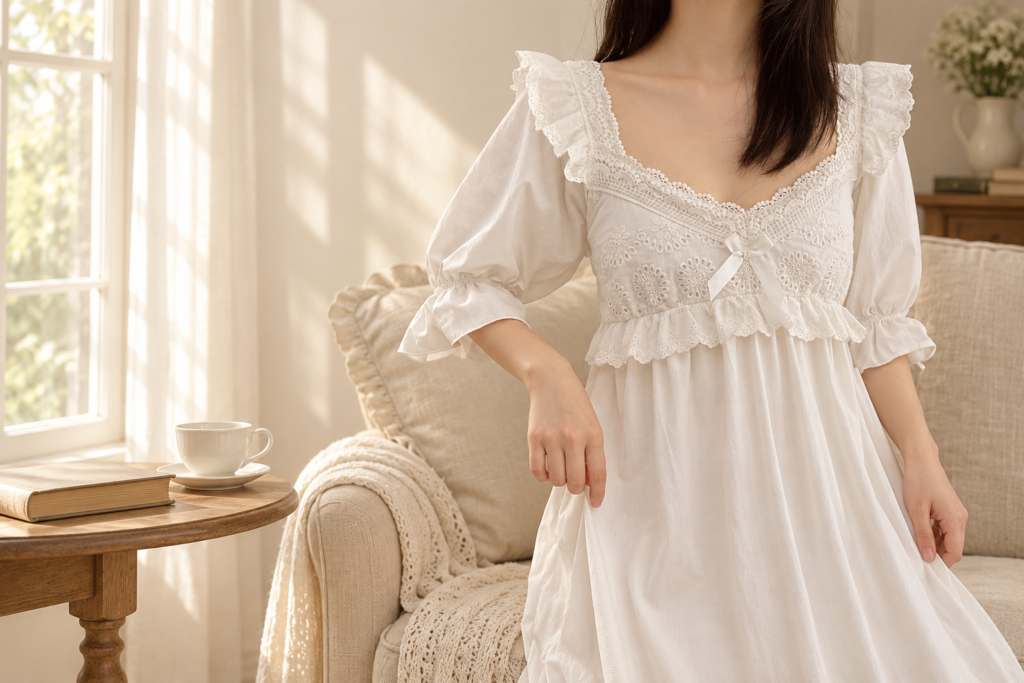
The pictured white version of Victorian Couture’s Vintage Victorian Cotton Lace Nightgown offers a contemporary example. Its neckline ribbon, eyelet decoration and shoulder ruffles give the upper part of the garment a distinct focus. The gathered fabric below adds a softer contrast to that detail.
This product is modern sleepwear. It is useful in this discussion because it offers a present-day way to enjoy decorative clothing at home, not because it reproduces either of the historical gowns described above.
Choosing romantic sleepwear for actual use
Decide what matters in your routine before choosing by appearance alone. Consider sleeve shape, neckline, length and ease of movement. A garment intended mainly for sleeping may meet different preferences from one chosen for a getting-ready photograph or a quiet evening of reading.
Check the size information and the exact variant shown. White fabric is not automatically opaque, and a lace detail does not establish whether a garment is lined. Look for explicit information about coverage and construction, or ask when that information is absent.
If you want a fuller discussion of those purchase decisions, our guide to choosing a Victorian nightgown covers fabric, length and fit. For the broader background of sleepwear itself, explore what a Victorian nightgown is.
Care and presentation
Treat decorative details as part of the garment’s care requirements. Follow the label for washing, drying and ironing rather than assuming every white or cotton-labelled item can be cleaned in the same way. Check ribbons and trims for snagging, and avoid pulling on delicate decoration when handling the garment.
For a photograph, use soft window light and a simple background so the design remains visible. A book or teacup can suggest a setting without concealing the clothes. Accurate color and visible detail are more helpful to someone choosing a product than a heavy filter.
Common questions about tea gowns
Is a tea gown the same as a nightgown?
No. The historical tea gown had a role in informal home entertaining. A nightgown is sleepwear. Similar trim or a flowing shape does not make the terms interchangeable.
Were tea gowns always white?
No. The decorated British silk example discussed here includes colored embroidery and lining. White is not a defining requirement of the category.
Does vintage-inspired mean genuinely antique?
No. It describes an influence on a design. When buying an actual antique, provenance and dating require separate evidence. A modern product can draw on older visual ideas while being made for contemporary use.
Can I enjoy this aesthetic without historical costume?
Yes. Choose a detail you like—a ribbon, a decorative neckline or gathered fabric—and consider how it fits your daily preferences. The history adds context; your needs determine the garment you choose.