Free Worldwide Shipping.

Vintage Nightdress vs Chemise: A Practical Guide
Understand the relationship between nightdresses, chemises and slips, and choose a shape that suits the way you dress at home.

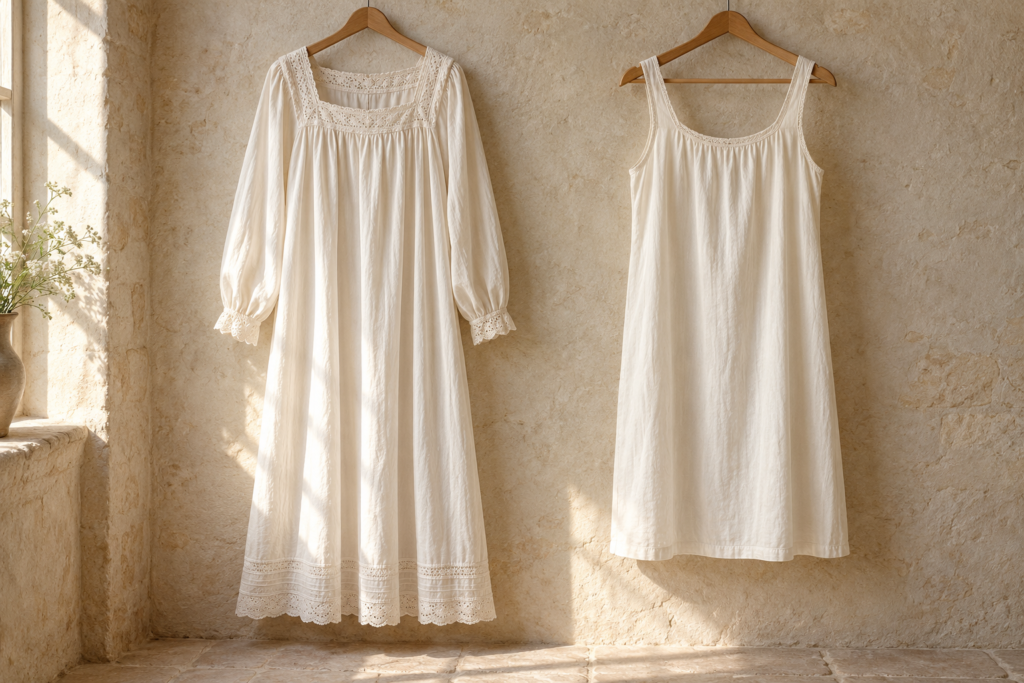
A vintage nightdress is chosen primarily for sleeping or relaxing, while a chemise has a longer history as a layer worn directly beneath other clothing. Their shapes can overlap, which is why the names sometimes appear together in shopping descriptions. The most useful distinction is the garment's intended role, followed by its cut: look at the neckline, sleeves, seams and room for movement. Understanding those details helps you choose between a flowing nightdress, a simple underlayer and a garment that can comfortably serve more than one purpose.
The chemise began as a practical foundation
The word chemise comes from the French word for shirt. Historically, the garment was worn next to the skin to protect outer clothing from perspiration and body oils. Linen and cotton made such layers washable. The subject is therefore as much about how clothing was worn and maintained as how it looked.
A surviving chemise dated 1851 in the V&A collection makes that function tangible. The museum describes a simple linen garment with a low square neck, short sleeves and a narrow frill. It also records a name and number used to identify the garment during laundering. Those small marks reveal an everyday object within a wardrobe, rather than merely a decorative piece.
That example is a useful reminder that a chemise need not mean the thin-strapped silhouette many shoppers first imagine. Sleeves and necklines have varied. One shape should not be used to define every garment carrying the name.
Where the vintage nightdress fits
Nightdress and nightgown are alternative names for loose nightwear. The sleeves, neckline, length and decoration can all vary. That breadth explains why two nightdresses can look less alike than a particular nightdress and chemise.
When comparing a vintage nightdress with a chemise, consider what must fit over it. A garment intended to sit beneath a dress needs to cooperate with the outer neckline, armholes and skirt. A piece worn on its own at home has more freedom to use a full sleeve, a substantial ruffle or a prominently decorated upper panel.
Each arrangement answers a different dressing need. For an overview of familiar shapes, the guide to Victorian nightgown features provides a useful companion.
Compare the role before the silhouette
The table below brings together historical usage and practical shopping considerations. Individual garments may cross these boundaries, so use it to frame questions rather than to relabel a product.
| Garment | Main role to consider | Useful feature to inspect | Question before choosing |
|---|---|---|---|
| Nightdress or nightgown | Sleeping and relaxing | Sleeve, skirt and neckline freedom | Can I move comfortably in it? |
| Chemise | Historically an underlayer; also used in lingerie descriptions | Smoothness beneath another garment | Does the cut suit the intended layer? |
| Full slip | Underlayer beneath a dress | Strap position, hem and surface | Will it remain discreet under this dress? |
| Robe or peignoir | Separate outer layer | Overlap, sleeves and fastening | What does it add over the base garment? |
A full slip is suspended from the shoulders, while a half slip is worn at the waist. If your main aim is an underlayer for a dress, those terms may lead you to a more specific option than searching for a chemise nightgown alone.
Read the neckline and shoulders together
A square neck can look similar across several garments, but the opening still needs to work with your shoulders. Try reaching forward and raising your arms. If the neckline shifts too far, the issue may be the width or depth of the opening rather than the bust measurement alone.
For a vintage nightdress worn by itself, an open neckline may be part of its appeal. Beneath another dress, that same opening needs to sit where the outer garment permits. Broad straps can offer more coverage but may show beneath narrow shoulder straps. A long sleeve can be comfortable for evening wear yet awkward beneath a fitted sleeve.
Fullness changes how the garment behaves
Look for where the fabric begins to widen. A vintage nightdress gathered below the bodice may provide a loose skirt while retaining a more defined upper section. A straighter garment can have less material around the waist, although that does not guarantee more room across the hips.
A shaped upper panel is called a yoke. This shaped panel supports the looser parts of a garment. That construction helps explain how an upper section can look organised while the fabric below falls freely. In a photograph, follow the seams rather than judging fullness only from the hem.
For sleeping, test the garment seated and with your arms forward. For layering, try it beneath the intended outfit. A roomy cotton nightdress may feel lovely on its own but leave too much fabric beneath a closely fitted skirt. Choose for the task you actually need it to perform.
Decoration should suit its position
The embroidered cotton nightgown illustrates a decorative approach, with a floral bodice, button-front detail and bishop sleeves. These features make sense as things to enjoy and see. They also give you concrete details to compare against the plainer surface you might prefer beneath another garment.
The ivory pintuck nightgown uses narrow folds, lace trim and short puff sleeves instead. Neither product needs to be called a chemise to explain the difference. Compare the actual upper panel and sleeves, then decide which arrangement suits your evening routine.
A vintage nightdress with noticeable trim deserves a closer look wherever that trim touches the skin. A decorative edge near the wrist feels different from one placed well below the knee. Consider placement alongside appearance, especially if you already know that certain seam positions bother you.
Choose for the way you dress at home
For a vintage nightdress you plan to wear most evenings, begin with movement and the details you enjoy seeing. If you mainly need an underlayer, begin with the outer garment it must fit beneath. Victorian Couture's sleepwear and lingerie categories offer different starting points without requiring every piece to fit a single historical label.
Frequently Asked Questions
Does a chemise provide built-in bust support?
Only expect this if the listing describes a supporting feature such as integrated cups or a built-in bra. A garment's name or close-looking bodice does not establish how much support it provides.
Is a vintage nightdress the same as a slip dress?
Not necessarily. A slip dress is designed as outer clothing with the appearance of an underslip. A nightdress is sleepwear, and its coverage and construction need separate consideration before wearing it outside.
Can a cotton nightdress be used beneath another dress?
Possibly, if its sleeves, seams and volume fit comfortably beneath that dress. Try both together and check for bunching at the waist and pulling around the armholes.
What should I search for if I need only an underskirt?
Try half slip or waist slip. Those terms are more specific to a lower-body underlayer than chemise nightgown, which may return full garments with quite different uses.
Can I wear a vintage nightdress with a separate robe?
Yes. Check that the robe sleeves accommodate the nightdress sleeves and that both hems remain easy to walk in. The pieces can coordinate without having identical trims.
Which measurements are useful when buying online?
Start with bust, garment length and any available shoulder or sleeve measurements. Compare them with a comfortable garment you already own, and check whether the listing gives body sizes or finished garment measurements.