Free Worldwide Shipping.

Vintage Nightdress and Robe Set: The Peignoir Explained
Understand the peignoir and compare the two layers of a nightdress and robe set, from fabric and coverage to fit and care.

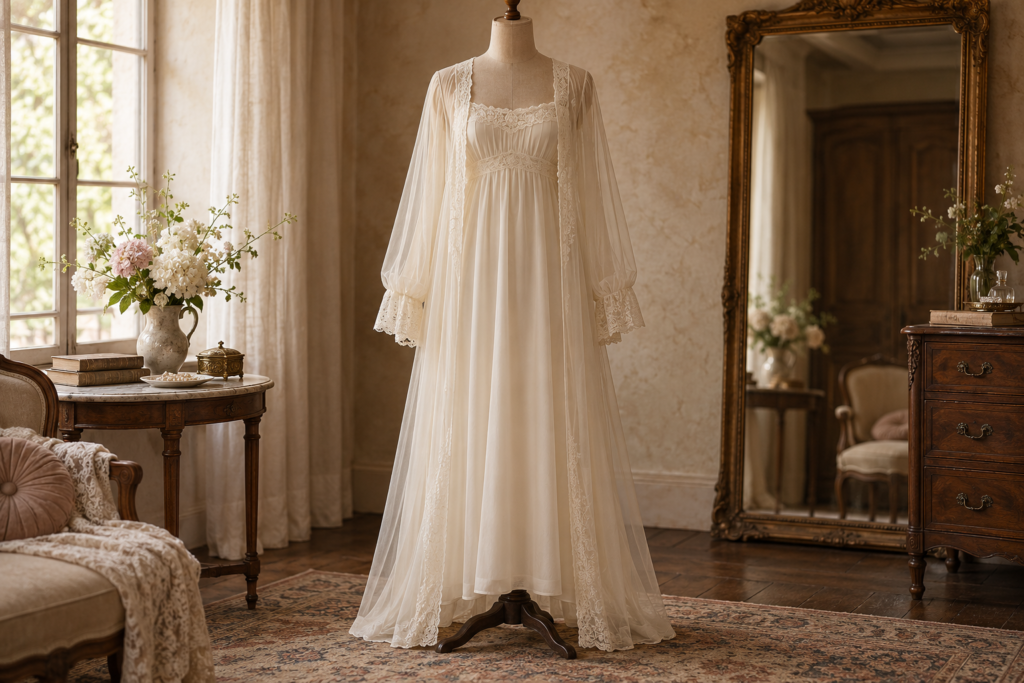
A vintage nightdress and robe set pairs a base garment with a separate outer layer, often using lace, fine netting or softly draped fabric to connect the two. The word peignoir usually refers to the robe rather than the nightdress underneath. That distinction helps when choosing a set: the inner piece determines much of the fit and coverage, while the robe changes the silhouette and overall appearance. Assessing both garments separately makes it easier to find a combination that feels as considered when worn as it looks in a photograph.
What is a peignoir?
A peignoir is a long women's outer garment, often sheer, whose name is connected with the French verb meaning to comb the hair. The term evokes dressing-room clothing: an outer layer worn while preparing for the day or evening. It is also associated with coordinated nightwear.
A robe can frame a neckline, change the outline of the sleeves or create movement over a simpler dress. Its contribution can be decorative even when the base garment provides the coverage.
In a peignoir set, the layers share the work. Wear the robe open to reveal the inner neckline, or loosely closed for a more continuous silhouette.
Look at the nightdress and robe set in two stages
First, imagine the nightdress without the robe. Would you enjoy wearing it on its own? Check the neckline, straps or sleeves, upper-body fit and hem. If those details do not suit you, a decorative outer layer is unlikely to make the base garment more useful.
Then consider the robe as a separate piece. Look at the shoulder line and sleeve opening, especially if you want to wear it over other nightwear. A loose-looking robe can still have a relatively narrow armhole, and a wide sleeve can become less practical when it extends beyond the wrist.
For a vintage nightdress and robe set, compare the measurements. A longer robe forms an outer border; similar lengths bring the hems together. Photographs alone cannot show where either will fall on your height.
Tulle, chiffon and lace are different materials
A sheer appearance does not identify one particular textile. Tulle is a fine netting that can be made from several fibres. The openings in the structure contribute to its transparent appearance. Tulle used for a flowing robe should still be assessed from its own description; the word alone does not tell you how soft or firm it feels.
Chiffon is a lightweight woven fabric rather than the same net structure. It can also be made from different fibres. This is why a fabric name and a fibre name answer separate questions: "chiffon" does not automatically mean silk, just as "tulle" does not automatically mean cotton.
Lace adds another form of pattern. A robe may have a plain sheer body with lace only at the front opening or cuffs. When choosing a lace robe, look for how much of the garment is actually lace and where the pattern sits. Those details will affect the visual balance with the dress beneath it.
| Element | What it contributes | What to inspect |
|---|---|---|
| Inner nightdress | Base silhouette and much of the coverage | Neckline, bust, length and lining information |
| Tulle outer layer | Fine net texture with visible transparency | Softness description, mesh and edge finishing |
| Chiffon outer layer | A light woven layer | Fibre composition and drape |
| Lace border or cuff | Pattern concentrated at an edge | Placement and contact with the skin |
| Tie or fastening | A way to position the robe | Whether it closes as much as you want |
Check the coverage of a nightdress and robe set
A nightdress and robe set can look more covered in a softly lit photograph than it does beside a bright window. Assess each layer and then the combination. A translucent outer robe may soften the view beneath it without making a translucent dress opaque.
For getting ready or lounging in shared rooms, choose coverage first and decoration second. If you already own a suitable nightdress, a separate robe may be all you need.
Try the combination seated as well as standing. An open-front robe changes position when you move, so the base garment should provide the coverage you are comfortable with on its own. It is better to settle that question during fitting than to keep rearranging the outer layer throughout the evening.
A closer look at a lace and tulle option
The lace tulle robe set combines a lace-detailed inner nightdress with a sheer outer robe and long flowing sleeves. Its specification identifies polyester tulle or mesh, so it should be appreciated for that particular construction rather than described as silk. The ribbon and lace details provide visual connections between the layers.
The listing also offers a complete set, a separate dress and a separate robe as selection options. Check which option you choose, because the photographs of both pieces do not mean both are included with every selection. This is a small but useful distinction whenever a nightdress and robe set shares a page with its individual components.
For a different arrangement, compare the robe with a plainer garment from the nightgown and sleepwear collection. A quieter inner dress gives a decorative lace robe more space to show its pattern. A detailed bodice, by contrast, may work best with an outer neckline that leaves it visible.
Make room for both layers
When trying a peignoir set, reach forward, bend your elbows and sit down. Look for places where the inner and outer seams meet awkwardly, or where one sleeve pulls the other. A combination that feels comfortable standing still should also suit the movements you make at home.
Care needs the same two-part attention. The linked tulle style specifies gentle hand washing in cold water, avoiding wringing and high heat. Follow the instructions for each actual garment, especially if you pair separately purchased pieces. Matching colours do not mean matching wash requirements.
Choose a combination you enjoy together and separately
A nightdress and robe set is most useful when you like the base dress, the outer layer and their combined proportions. Start with those three views rather than the amount of decoration. The lingerie collection at Victorian Couture provides a place to compare layered options and decide which details belong in your own evening wardrobe.
Frequently Asked Questions
Do I need to sleep in both pieces?
No. Use the nightdress alone if the robe's sleeves, ties or extra fabric get in your way. You can keep the outer layer for getting ready or lounging.
Does a nightdress and robe set always include both pieces?
Check the selected option and package description. Some product pages sell the complete combination and the individual garments through the same listing, so the photograph alone is not enough.
Can I mix a robe with a nightdress I already own?
Yes. Compare sleeve space, neckline and length, then try the pieces together. They do not need identical trims if their proportions and colours work for you.
Is tulle necessarily silk?
No. Tulle describes a net textile and can be made from different fibres. Read the composition for the specific garment rather than inferring it from a sheer appearance.
Can I buy a nightdress and robe set as a gift?
Use the recipient's measurements where possible and check both garments' size information. Also confirm the return conditions and whether the selected option contains both pieces before ordering.
How can I store a delicate robe between wears?
Choose a place where its trim will not catch on exposed hooks, zips or rough surfaces. Follow any hanging or folding advice supplied with the garment, and avoid leaving long hems pooled on the floor.