Free Worldwide Shipping.

Pintuck Nightgown: Folds, Gathers & Victorian Style
Learn to recognise pintucks and understand how narrow folds, gathered fabric and lace work together on a nightgown.

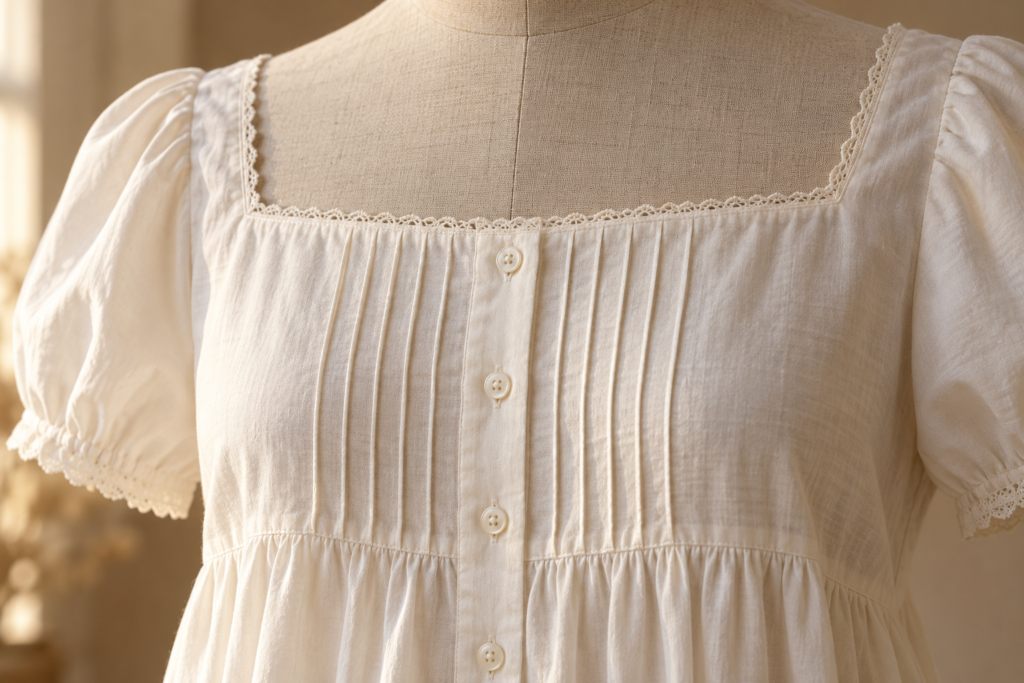
A pintuck nightgown is decorated with very narrow folds stitched into the fabric. These raised lines can frame a neckline, organise the bodice or add interest to otherwise plain cotton. Unlike a printed stripe, a pintuck is part of the cloth's construction. The detail is especially useful to recognise when shopping online because it can sit beside gathers, lace and larger pleats, each doing something different. Looking at how those elements meet tells you more about a nightgown's shape than treating every fold as the same kind of decoration.
What exactly is a pintuck?
A tuck is a fold held in place, while a pintuck is a particularly narrow version. Several parallel rows can decorate a garment without introducing another fabric or colour. The detail relies on repeated small ridges and the shadows between them.
To recognise a pintuck nightgown in a photograph, look for narrow, regular lines with stitching close to the fold. They may run vertically down an upper panel or appear in groups. A fold created by the way the garment hangs will move and change direction; a sewn detail follows its constructed path.
A detail photograph should reveal where the rows begin and end, which draped fabric may hide. Compare it with the styled image to see the complete arrangement.
A small detail with a long clothing history
Tucks became especially popular during the later nineteenth century as sewing-machine production expanded. They appeared on fine cotton and linen lingerie, blouses and children's clothing. A Victorian cotton nightgown with tucked decoration belongs visually to that wider vocabulary of carefully worked pale fabric.
A few rows near the neckline create a quiet effect; a broad panel becomes the bodice's main feature. The folds' scale, spacing and surrounding plain fabric determine the arrangement.
When choosing a pintuck nightgown, consider both the fine lines close up and the panel's place within the whole silhouette.
Pintucks, pleats and gathers do different jobs
These words describe related ways of arranging fabric, but they should not be used interchangeably. Pleats are made by doubling fabric back on itself. Pleats may be sharply pressed or left to fall more softly, and their width can vary substantially.
Gathering draws a wider fabric edge into a shorter length, producing many small folds. On a nightdress, you might see this where a generous skirt joins an upper panel. The gathered edge contains the fullness at the seam while allowing the fabric below to spread out.
A pintuck nightgown can combine neat rows at the chest with soft gathers below. That gives a defined upper section and a looser skirt without making the tucked area stretchy.
| Feature | How to recognise it | What to notice on a nightgown |
|---|---|---|
| Pintucks | Fine, stitched folds in repeated lines | Whether the panel has enough room across the chest |
| Larger pleats | Wider folds with a clear direction | Where the folds are secured and where they open |
| Gathers | Small folds drawn together along a seam | Where the garment gains fullness |
| Yoke | A shaped supporting panel | How the shoulders and upper body support the loose fabric |
The last feature is a shaped piece that supports looser garment sections. It is a panel, not a kind of pleat. Following that distinction makes a product description easier to picture.
Read the bodice before the hem
A cotton pintuck nightdress can have a wide skirt and still feel close across the upper body. Begin with the panel where the rows sit. Check the bust measurement and look for a front opening, neckline shape and any seam beneath the tucked section.
Follow the fabric downwards. Notice where the rows end, where gathers begin and whether the two sit beside a fastening. These details show where the garment gains its fullness.
For a pintuck nightgown you plan to sleep in, movement matters more than the number of rows. Compare its measurements with a comfortable nightdress, particularly if you reach forward or curl up while sleeping. Generous fabric at the hem cannot compensate for a restrictive upper panel.
A closer look at an ivory design
The ivory cotton pintuck nightgown combines a tucked bodice with a square neckline, lace trim and short puff sleeves. The listing identifies the main fabric as 100% cotton. It is a useful example of several different details sharing the upper part of a garment without relying on contrasting colour.
On this cotton pintuck nightdress, the folds provide repeated lines, the lace outlines an edge and the gathered sections introduce fullness. Each contributes something different to the appearance.
For an alternative, the embroidered cotton nightgown places more emphasis on a floral bodice and long sleeves. Compare it with the quieter lines of the tucked design.
Pairing and caring for a pintuck nightgown
A plain robe can leave a pintuck nightgown's upper panel visible without adding more competing lines. Try an open neckline on the outer layer if the tucked bodice is the part you most enjoy. If you prefer to wear the garment by itself, the repeated folds provide interest without needing additional accessories.
For care, follow the instructions for the entire garment, including lace and fastenings. The linked ivory style specifies a cold gentle machine wash, hanging to dry and low-temperature ironing if needed. Those directions apply to that product; a different combination of fabric and trim may need another routine.
After washing, check how the rows lie before pressing. Avoid creating new crosswise creases through them, and do not pull at the stitching to straighten a fold. If the label permits ironing, work carefully around the decorative edges rather than treating the bodice as an uninterrupted flat panel.
Choosing the amount of detail that suits you
A Victorian cotton nightgown can feel decorative through construction alone. The sleepwear collection at Victorian Couture lets you compare tucked, embroidered and lace-trimmed designs. Choose a pintuck nightgown for the arrangement you enjoy, then confirm that its upper panel, sleeves and opening give you the movement you need.
Frequently Asked Questions
Does the nightgown need ironing after every wash?
That depends on the care label and how crisp you want the finish to look. Let it dry as directed first, then decide whether any creases need attention; do not apply extra heat simply because the garment has folds.
Does a pintuck nightgown stretch across the bodice?
Do not assume so. The folds are held in place, and any stretch depends on the fabric and construction. Check the actual garment measurements rather than counting the visible folds as spare room.
Are more rows a sign of better quality?
Not by themselves. Row count describes the design, while neat construction, suitable materials and comfortable fit are separate considerations. A restrained panel can be just as appealing as a densely tucked one.
Can pintucks and embroidery appear together?
Yes. Narrow folds can frame an embroidered panel or alternate with decorative bands. Look at the complete layout to decide whether you prefer that combination or a simpler arrangement.
What if I prefer less lace around my face?
Look for a narrower neckline border or decoration concentrated lower on the bodice. The pintucks can provide the main interest without requiring a wide lace edge.
Can I remove the stitching to make the garment wider?
Do not treat decorative folds as an alteration allowance. Removing them may leave marks and change the relationship between adjoining panels. Ask a dressmaker before attempting a change.